

AlphaSignal Portfolio Update Fresh Buy and Sell Alerts Across 176 Stocks

Market leadership is rotating fast, and the latest AlphaSignal scan produced a clear message: momentum is still active, but risk control now matters as much as entry timing.
The AlphaSignal quantitative models screened the full coverage universe of 176 tracked equities and generated a new round of buy and sell alerts across both proprietary model sets, Algo 1 and Algo 2. The result is a high-activity signal day, with fresh momentum entries in select sectors and disciplined exit alerts in areas showing signs of deceleration.
This update summarizes the latest systematic alerts, current model readings, and key performance metrics from the AlphaSignal framework. The data below is based on today’s internal model output and is intended for informational purposes only. It is not financial advice or a recommendation to buy or sell any security.

Today’s scan produced fresh entries and risk exits
The strongest feature of this update is the split between aggressive momentum detection and firm exit discipline.
Algo 1 triggered active entry alerts in five names: DAN, DCO, FSI, TBBK, and VRNS. These are not broad watchlist additions. They are current model entries generated by the AlphaSignal scan based on momentum alignment inside the tracked stock universe.
Algo 2 produced a much broader set of activity. The model flagged 26 total entry alerts, including large and high-profile growth names such as BKNG, MELI, NOW, ROKU, SPOT, UBER, VST, and WIX.
At the same time, Algo 2 also triggered 11 exit alerts. These exits include several major semiconductor and technology names, such as AMAT, KLAC, LRCX, PLTR, and SNOW.
That combination matters. A strong systematic model should not only identify potential upside. It should also identify when momentum is fading, when risk is rising, or when a prior position no longer fits the model’s current conditions.
The AlphaSignal trading system, quantitative stock signals, algorithmic trading alerts framework is built around that core principle: enter when evidence supports the setup, exit when the setup weakens.
Algo 1 flagged five active entry alerts
Algo 1 generated a more concentrated set of buy signals in today’s scan. The model flagged five active entry alerts across the 176-stock universe.
Ticker | Alert type | Current price shown in model summary | 1-year Algo 1 return shown |
DAN | Entry | $29.04 | Not provided |
DCO | Entry | $170.67 | +339.17% |
FSI | Entry | $6.17 | Not provided |
TBBK | Entry | $49.05 | Not provided |
VRNS | Entry | $48.68 | +152.69% |
The standout readings in this group are DCO and VRNS.
DCO shows a +339.17% 1-year Algo 1 return in the model summary. VRNS shows a +152.69% 1-year Algo 1 return. These figures point to strong historical model performance for those signals over the measured period.
That does not mean the next trade will repeat prior performance. Momentum systems can go through periods of false starts, sharp reversals, and lower follow-through. Still, when a stock appears on a fresh entry list and has already demonstrated strong model behavior, it deserves closer monitoring in the live dashboard.
Why the concentrated Algo 1 list matters
A narrow entry list can be more meaningful than a broad screen when the model is designed to filter for tighter conditions.
Today’s Algo 1 alerts suggest select pockets of strength rather than a blanket risk-on reading. That distinction is important for active traders. A broad rally can lift weaker setups. A narrow signal set forces the model to be more selective.
For traders tracking systematic entries, the main focus should be the relationship between:
Signal price
Recent trend strength
Volatility profile
Exit level
Position size
Market regime
The alert itself is only the first step. Execution still requires discipline.
Algo 2 expanded with 26 buy alerts
Algo 2 produced a much wider entry pulse, with 26 total assets triggering buy alerts today.
The group includes several market leaders and growth-oriented names:
Ticker | Alert type | Category shown in summary |
BKNG | Entry | Travel and consumer platform leader |
MELI | Entry | E-commerce and fintech growth leader |
NOW | Entry | Enterprise software leader |
ROKU | Entry | Streaming platform and connected TV |
SPOT | Entry | Digital audio platform |
UBER | Entry | Mobility and delivery platform |
VST | Entry | Power and energy market leader |
WIX | Entry | Web platform and software provider |
This type of broad Algo 2 activity suggests that the model is detecting enough momentum strength across multiple segments to justify new entries. The signals are not limited to one narrow industry group.
That spread is important. When entry alerts cluster across software, consumer platforms, energy, and internet leaders, it can point to broader participation beneath the surface of the market. If those signals continue to hold, it may support a stronger risk appetite across growth equities.
By contrast, if the entry list quickly reverses or the exit list expands, the signal environment may be turning more defensive.
The key reading from today’s AlphaSignal scan is not only the number of buy alerts. It is the balance between fresh entries and timed exits across the same universe.
Exit alerts show strict profit discipline
Algo 2 also triggered 11 exit alerts. These alerts are central to the AlphaSignal process because they identify positions where the model no longer supports continued exposure.
The current exit list includes several major technology and semiconductor names:
Ticker | Alert type | Price shown in model summary |
AMAT | Exit | $415.39 |
KLAC | Exit | $168.30 |
LRCX | Exit | $266.20 |
PLTR | Exit | $186.65 |
SNOW | Exit | $307.35 |
The presence of semiconductor and technology names on the exit list is especially important. These groups often carry high momentum sensitivity. When they lead, they can produce strong multi-week or multi-month runs. When momentum fades, drawdowns can also develop quickly.
An exit alert does not imply a company is weak, broken, or uninvestable. It simply means the model no longer sees the same favorable setup based on current conditions.
For systematic traders, that distinction is critical. A model does not need to form an opinion about a company’s long-term story. It tracks price behavior, momentum, trend quality, and risk conditions. If those inputs deteriorate, it steps aside.

Performance metrics continue to favor the systematic model
The latest performance snapshot shows a strong gap between Algo 2 model returns and the benchmark buy-and-hold comparison shown in the AlphaSignal summary.
Portfolio metric | 1-year return summary |
Algo 2 average 1-year return | +71.83% |
Benchmark buy and hold | +16.50% |
Algo 2 top performer, MU | +2,479.18% |
Algo 2 runner-up, AAOI | +1,879.67% |
Average current year forecasted growth | +134.33% |
The headline figure is the +71.83% average 1-year return for Algo 2, compared with the +16.50% benchmark buy-and-hold return shown in the model summary.
The top performer, MU, posted a listed Algo 2 return of +2,479.18%. The runner-up, AAOI, posted +1,879.67%.
These are extreme outliers, and they should be treated as such. Outlier winners can have a large effect on model averages, especially in momentum strategies. That is why risk controls, exit signals, and portfolio sizing remain essential.
The average current year forecasted growth figure is listed at +134.33%. Forecasted figures require caution because markets can change quickly. A forecast is not a guarantee. It is a current model estimate based on the system’s latest readings.
Why entry and exit signals must be read together
Many traders focus only on buy alerts. That is incomplete.
A buy signal helps identify where momentum may be building. An exit signal shows where that momentum may be fading. The strength of a systematic process comes from using both.
Today’s alert set creates three distinct categories:
Signal category | Current reading | Trading implication |
Algo 1 entries | 5 active alerts | Concentrated momentum setups |
Algo 2 entries | 26 active alerts | Broader growth and leadership participation |
Algo 2 exits | 11 active alerts | Risk reduction and gain preservation |
This mix does not call for emotional reaction. It calls for process.
Fresh entries point to new areas of possible strength. Exits protect capital when the model senses deterioration. The real value comes from following the framework consistently rather than reacting to headlines, price spikes, or fear of missing a move.
That is where systematic trading has an edge for disciplined operators. It creates a repeatable way to process stock market signals, buying alerts, portfolio viewing access, market forecast 2026, systematic trading inputs, and shifting risk levels without relying on instinct alone.
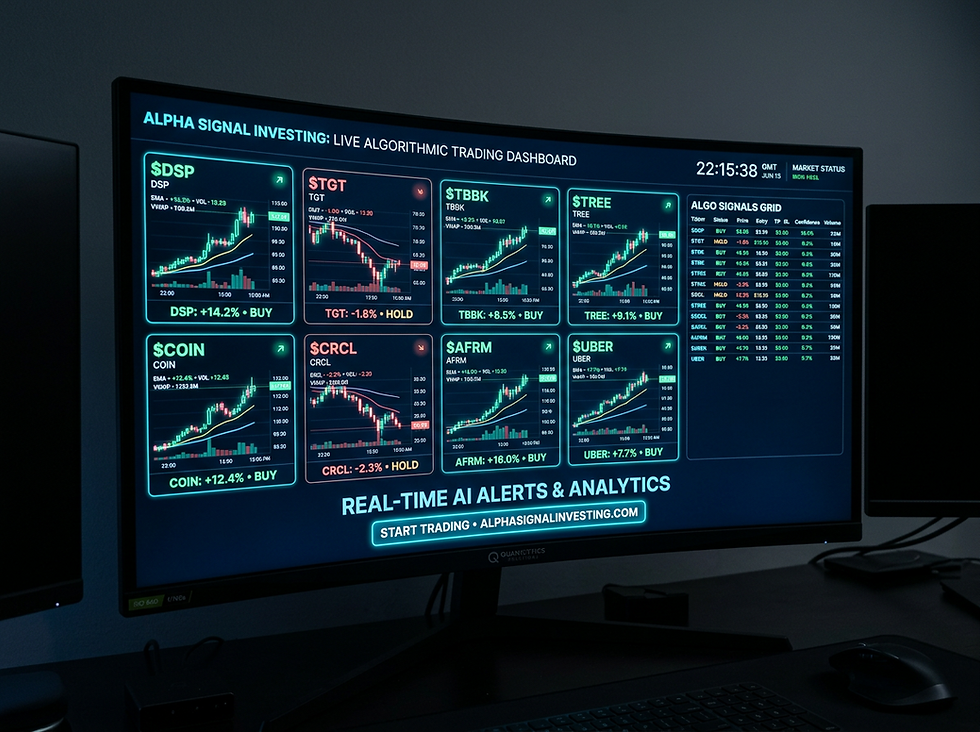
What the full live dashboard adds beyond this summary
This update covers only a portion of the active AlphaSignal tracking system. The full live dashboard is designed to provide the complete view behind the summary numbers.
A full dashboard view typically matters because traders need more than ticker symbols. They need the surrounding context that determines whether a signal fits their plan.
The most important data points include:
Real-time buy and sell alerts
Entry prices and current signal status
Model-specific tracking for Algo 1 and Algo 2
Full coverage across all 176 equities
Current return readings
Active exit levels where available
Sector-level signal activity
Updated model rankings and changes
The difference between a summary and a live dashboard is timing. A written update captures one point in the model cycle. Live access shows how the signal set changes as prices move.
For active traders, that timing gap can matter. A signal can strengthen, fade, reverse, or move beyond an acceptable entry range. The dashboard helps separate current model alignment from stale information.
How to read today’s alert mix
The current AlphaSignal reading is neither fully defensive nor blindly aggressive. It is selective.
Algo 1 is showing a focused list of entries. Algo 2 is showing broader participation with 26 buy alerts. At the same time, Algo 2 is actively removing exposure from 11 positions.
That balance supports a practical interpretation:
Momentum remains present
The number of entry alerts, especially in Algo 2, shows that the model still sees strength across important growth and leadership names.
Risk control is active
The 11 exit alerts show that the system is not simply adding exposure without regard for weakening trends.
Leadership is rotating
Buy alerts in one group and exits in another suggest that capital may be moving across sectors rather than lifting all names equally.
Execution matters
Traders should avoid treating alerts as open-ended signals. Entry discipline, exit rules, and position sizing remain central.
This is the type of market where model discipline becomes more valuable. Selectivity matters. Chasing every strong chart can increase risk. Ignoring fresh signals can leave opportunity on the table.
The AlphaSignal update gives a structured way to track both sides.
Key takeaways from the latest AlphaSignal portfolio update
Today’s scan across 176 tracked equities produced a meaningful signal set.
Algo 1 generated five active entry alerts in DAN, DCO, FSI, TBBK, and VRNS. DCO and VRNS stand out for their listed 1-year Algo 1 returns of +339.17% and +152.69%.
Algo 2 generated 26 entry alerts, including BKNG, MELI, NOW, ROKU, SPOT, UBER, VST, and WIX. That breadth points to active momentum across several leadership groups.
Algo 2 also triggered 11 exit alerts, including AMAT, KLAC, LRCX, PLTR, and SNOW. These exits reinforce the central AlphaSignal principle: protect capital when the model reading weakens.
The performance snapshot remains strong, with a listed +71.83% average 1-year Algo 2 return versus a +16.50% benchmark buy-and-hold return. MU and AAOI remain the top listed performers in the summary, with returns of +2,479.18% and +1,879.67%.
The main takeaway is direct. The market is still producing opportunity, but the strongest process is not prediction. It is disciplined signal tracking, timely entries, and firm exits when the data changes.
Disclaimer:
The content provided in this blog post and via AlphaSignal LLC is for informational, educational, and analytical purposes only and does not constitute financial, investment, or trading advice. Past quantitative or backtested performance is not indicative of future results. All trading involves capital risk. Always consult with a licensed financial advisor prior to making investment decisions.


Comments